
Many of our young forests are excessively
dense and have virtually no undergrowth. Can we do something to
these forests to enhance their prospects as habitat for old-growth
associated species? 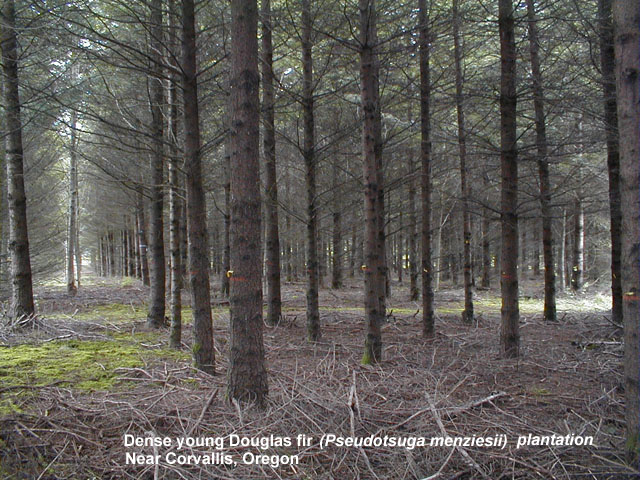
Traditional, uniform thinning of already dense forests has relatively subtle effects on lichens and bryophytes (Peterson & McCune 2001a; Rosso et al., 2000a, Thomas et al. 2001). Dense forests rarely have well-developed lower branches (see also Esseen et al. 1996). Even heavy thinning would often do little to create new habitat at the bottom of the vertical profile.
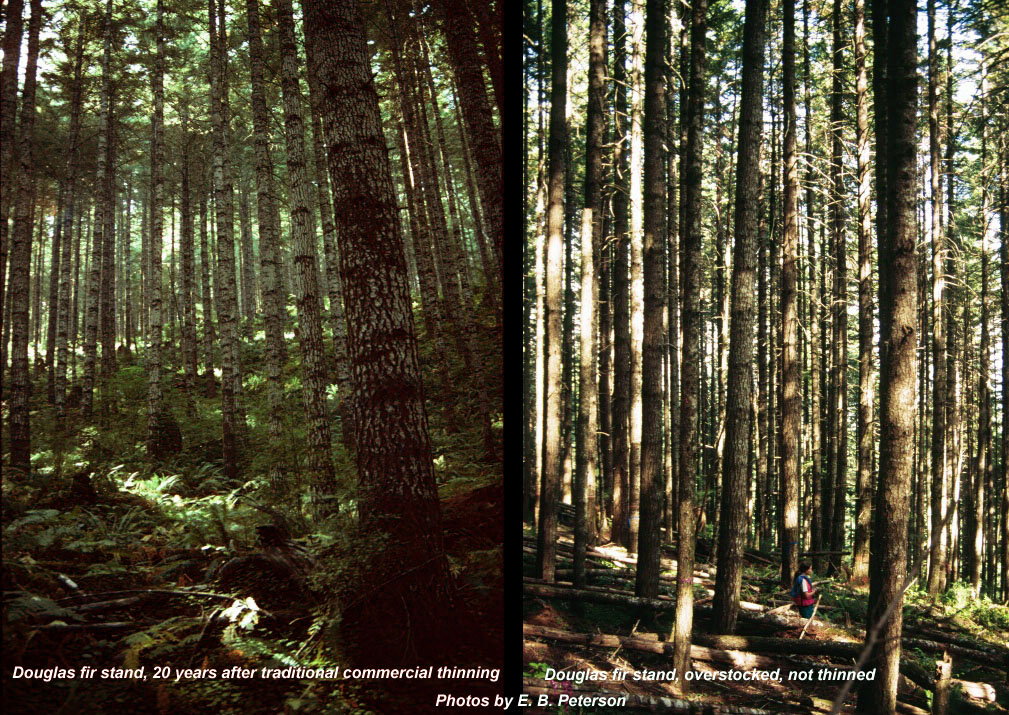
But if we expand the concept of thinning to include variable densities and promoting lichen hotspots, then we should be able to make significant contributions to lichen diversity 20 to 50 years from now (Neitlich & McCune 1997; Rolstad et al. 2001). Hotspots are areas with greater than average diversity and abundance of old-growth associates. See "How can we recognize lichen hotspots?"
In some cases, structurally heterogeneous young forests that include gaps and remnant trees may host greater lichen diversity biomass than even a dense old-growth stand (Neitlich & McCune 1997, Pipp et al. 2001). Pipp et al. (2001) found that forest structure was more strongly related to lichen diversity and biomass than was forest age per se. Stand age, however, was more strongly related to species composition than was forest structure.
Neitlich and McCune (1997) studied variation in young, managed forests. They found that protecting gaps, wolf trees, and old-growth remnant trees is likely to promote most epiphytic macrolichens, especially those sparsely distributed on the landscape or requiring specialized habitats. Because these features are easily recognized on aerial photos and on the ground by non-lichenologists, it is practical to manage for forest structures that would promote lichen diversity. Such management is likely to yield more frequent occurrence of cyanolichens and forage lichens in our landscape of abundant young forests. While this biodiversity is valuable in its own right, the functional roles of these groups, such as nitrogen-fixation and forage are also likely to be enhanced.
Enhancing habitat for one group of species often detracts from habitat for another group of species, because diversity of different groups responds to different factors (Berg et al. 1994; McCune & Antos 1981a, b). In this case, however, it appears that the same structural features identified here could have a positive effect on many groups of organisms (e.g. see Pettersson et al. 1995, Muir et al. 2002), by reintroducing structural diversity into otherwise relatively monotonous young forests.
Has this idea been tested? No, not in the Pacific Northwest. Clearcutting has been so popular in mesic forests that we have few stands with a long history of uneven-aged management. In Norway, however, old-growth like structure has been produced after 100-150 years of uneven-aged management (Storaunet et al. 2000). Rolstad et al. (2001) described the status of epiphytes in these forests.
The following recommendations will promote the diversity and abundance of old-growth associated lichens, as well as many other groups of old-growth associated organisms:
1. Avoid "black holes" -- overstocked stands with virtually no undergrowth.
2. Use variable-density thinnings, leaving a diversity of structural elements, such as
3. Use green-tree retention wherever possible.
4. Avoid cutting trees in hotspot habitats, including outcrops and talus, riparian areas, ridgetops, and sites infertile because of thin or coarse-textured soils.