
The answer to this question is intuitively known by field lichenologists. So you could answer this question by dropping off a vanload of lichenologists in the woods, then following them around to see where they go. Most of them would seek out special habitats, such as rock outcrop areas, edges of wet meadows, old-growth stands, isolated old trees in younger forests, and riparian areas. Researchers have taken a perhaps more convincing approach of recording lichen communities in plots in many different habitats, and seeking the focal points of diversity and rare species in the data.
The long answer consists of a list of special habitats, along with evidence that supports the conclusion that there is some component of lichen diversity that is especially frequent in that habitat. At the end of this page is a summary sheet that could be used to "score" tracts of land for lichen habitat.
Before we begin the list, we need to discuss a premise that some readers will already be questioning: why should we expect to find habitat that is "good" for all species? Of course different species of lichens occupy different habitats, just as different species of birds occupy different habitats. To someone seeking a high diversity of unusual bird species, good habitat consists of concentrations of special habitats. The same is true for epiphytic lichens. We cannot, however, expect to find a single habitat that is favorable for all species.
Hotspots
The Northwest Forest Plan (USDA and USDI 1994) recognized nine epiphytic lichen species as "riparian lichens." Peterson & McCune (2001b) and Rosso et al. (2000b) found higher species diversity in riparian hotspots. Ruchty (2000) focussing on riparian lichens in particular, described a gradient in riparian lichen communities in the Coast Range of Oregon, from narrower, conifer-dominated valleys in the upper watersheds to agricultural corridors and hardwood-dominated stands in the larger valleys. McCune et al. (2001) working in the McKenzie watershed of the Oregon Cascades, found that lichen species considered at risk by a government agency were 57% more frequent in riparian areas along large streams than in uplands or along small streams.
One very rare species endemic to the Pacific Northwest, Hypotrachyna riparia, is known only from riparian areas in the foothills of the Cascades (McCune 1998). For other riparian-associated epiphytic lichens, see the long answer under "Which species depend on riparian areas?"
One of the most conspicuous lichens seen in the riparian zone in western Oregon is Usnea longissima. Although it is listed with the riparian species in the NW Forest Plan, Keon (2001) found that it is not particularly a riparian species in the central coast range of Oregon, being more of an old growth associate and commonly occurring on slopes and ridges. In the foothills of the Cascades, however, Usnea longissima may indeed be a riparian species.
We have very little plot-based data on the importance of outcrops and talus to epiphytes. Yet it is clear that rocks are important to lichens that grow on trees. The reason is that rock can "enforce" openings in the forest, creating permanent edge habitat in which many lichens thrive.
 Furthermore,
the rocks themselves can be home to threatened lichens. Two local
examples are Pilophorus nigricaulis and Stereocaulon
spathuliferum. Pilophorus nigricaulis occupies rock
surfaces on cool north slopes with lots of diffuse light, but
infrequent direct light. Stereocaulon spathuliferum is
found in similar habitats but on sheltered rock faces that receive
little direct precipitation.
Furthermore,
the rocks themselves can be home to threatened lichens. Two local
examples are Pilophorus nigricaulis and Stereocaulon
spathuliferum. Pilophorus nigricaulis occupies rock
surfaces on cool north slopes with lots of diffuse light, but
infrequent direct light. Stereocaulon spathuliferum is
found in similar habitats but on sheltered rock faces that receive
little direct precipitation.
Despite the importance of rock outcrops to lichens and many other organisms, these special habitats are often not recognized as such. Traditionally logs were dragged over them, landings placed on top of them, and no buffers left when cutting around them. All of these practices should be discouraged. Talus and rock outcrops themselves support rare species and the trees and shrubs along their edges tend to have rich communities of epiphytes, including old-growth associated species listed in the NW forest plan.
How big does a rock outcrop or pocket of talus need to be for it to be considered a special habitat? We don't have an empirical answer to that question. Logically, however, if the narrowest dimension of the area of rock is larger than twice the radius of the surrounding tree crowns, then the rock will enforce an opening in the canopy. In most of our forests, this would be a patch of rock larger than about 10-15 m wide (30-50 feet).
In the moist forests of the Pacific Northwest, the breezy, more open conditions of ridgetops encourage lichen epiphytes as opposed to bryophytes. Ridgetops often have thin soils and rock outcrops, reducing tree cover and favoring epiphytes. Ridgetop trees are well positioned to collect fogwater as it drifts across a ridge. Similarly, ridgetops will dry more quickly. The frequent wetting and drying cycles apparently favor lichens rather than bryophytes.
Data supporting the previous paragraph are purely observational. The phenomenon is dramatically illustrated by the red alder (Alnus rubra) forests in the coastal mountains. In closed forests at the bottoms of steep, narrow drainages, red alders have sparse lichen cover, mainly on the treetops, but often heavy bryophyte cover. On nearby ridges the trunks are completely white with crustose lichens, supplemented by large tufts of macrolichens, such as Usnea, Sphaerophorus, Platismatia, and Hypogymnia.
Finally, we hypothesize that ridges are important to lichen populations because they are well positioned to act as a source of lichen propagules. Ridges are often windy and propagules launched from a ridge are more likely to travel a long distance than propagules launched from lower positions in the landscape. Because many lichens are dispersal limited (Sillett et al. 2000, 2000b), protecting populations of rare lichens in probable source areas (such as ridges) may promote the return of lichens to nearby young forests.
Sites with poor soils or thin soils often have a permanently sparse canopy. The trees and shrubs on such sites tend to have very well developed epiphytes. Historically, cutting operations often used poor sites as sacrificial areas (landings, quarries, parking machinery, etc.). Poor sites for tree growth, however, may be very interesting for other plants, lichens, and fungi. The fact that these sites have low potential for tree growth allows the development of interesting communities of epiphytes, as well as herbaceous plants. They should, therefore, be recognized as focal points for biodiversity and protected accordingly.
All of the available evidence points to the same conclusion: that remnant trees in young stands foster the development of old-growth associated lichens. Remnant trees are hotspots for diversity of old-growth associated species in young stands (Neitlich & McCune 1997). Biomass of old-growth associated lichens is higher in mature stands with remnant trees than in adjoining stands without remnant trees (Peck & McCune 1997a). When a mature 2-hectare stand with variable retention was mapped for Lobaria litterfall, biomass was found to be higher near remnant trees (Sillett & Goslin 1999). Underlying all of these results is inherently poor dispersal of many old growth associated species, as demonstrated for Lobaria oregana (Sillett et al. 2000).
For more information on remnant trees, see the answer to the question: Do remnant trees promote maintenance of old-growth associated lichens?
Oregon ash trees are particularly rich in cyanolichens, including many survey-and-manage species (Ruchty 2000). Oregon ash is an important forest component in only in the major valleys and valley fringes. Typically it is found in wetlands and riparian areas. Because of this, Oregon ash receives some protection from wetland laws. It is, however, a slow-growing species, so older ash swamps and isolated trees that are destroyed are only very slowly replaced by mitigation efforts.
We don't really know why Oregon ash makes such a good habitat for cyanolichens. Some hypotheses are its relative non-acidic, absorbent bark, its tendency to form relatively open, sparsely foliated canopies, and its association with habitats that are wet for much of the year.
Old-growth forests favor certain lichen species that are much less frequent or absent in young forests. This conclusion has been reached everywhere in the world that this problem has been studied. For more information, see the section on "Which species depend on old-growth forests?"
Pockets of hardwood trees and shrubs are focal points for lichen diversity in conifer-dominated forests. Similarly, conifers can be focal points for diversity in hardwood-dominated forests. In young, monotonous Pseudotsuga - Tsuga forests, pockets of hardwoods have been called "hardwood gaps" (Neitlich & McCune 1997), because they fill gaps in the nearly continuous canopy of conifers. They found hardwood gaps not only with enhanced diversity of cyanolichens, but also better development of many of the common macrolichens. Hardwoods are focal points for lichen diversity in other conifer forests of the world as well (Dettki & Esseen 1998, Esseen et al. 1997, Kuusinen 1996a).
Hardwood gaps are created in many ways, including local disturbances (such as colonies of mountain beaver, Aplodontia rufa), areas with thin soil over rock, and seepage areas on slopes or in ravines. Hardwoods are also commonly associated with riparian areas, often initiated by soil disturbance (erosion or deposition) during floods.
Deciduous hardwoods, such as Acer, Fraxinus, and Quercus seem especially important in the Pacific Northwest, perhaps because the absence of leaves in winter creates a relatively bright, open environment during the wet season. The most abundant deciduous hardwood in mountain forests, red alder (Alnus rubra), hosts a distinctive epiphyte flora, but does not seem to favor cyanolichens and old-growth associated species as much as the other hardwoods mentioned above.
Evergreen hardwoods, such as madrone (Arbutus menziesii) and chinkapin (Castanopsis chrysophylla) have not been studied in a formal way, but consider these observations. Evergreen hardwoods can have well developed epiphytes, but tend to a mix of lichen species less different from the surrounding conifers than other hardwoods. The smooth, peeling bark of madrone regularly sheds epiphytes, but old trunks can develop a heavy growth of cyanolichens. Dead branches of madrone often accumulate heavy epiphyte loads as well.
The importance of hardwoods as focal points of diversity in conifer-dominated systems seems to be in conflict with the traditional attitude of land managers toward hardwoods: "...within the forestry community there has been a persistent image of hardwoods as an overabundant resource, and foresters have viewed hardwoods as economically undesirable competitors of the preferred and better recognized softwoods species. Along with the image of overabundance in the woods has come the image of low-valued manufactured products and underuse of available raw materials by the hardwood industry" (Raettig et al. 1995). This view resulted in widespread use of herbicides and other measures to control hardwoods in the Pacific Northwest. Yet Raettig et al. point out that, "Immediate and long-run hardwood supply prospects... are in doubt." From both conservative and consumptive viewpoints it is important to manage for hardwoods.
Persistent openings or hardwood gaps in young forests often result in the development of "wolf trees." These are conifers with large, living lower limbs. Originally a derogatory term applied by foresters to relatively open-grown trees with poor form (from the standpoint of sawlogs), wolf trees can be valuable epiphyte habitat (Neitlich & McCune 1997). Many of the lichen species associated with hardwood gaps in young forests are actually found on the large, living, lower branches of conifers on the edge of the gap.
In northern Idaho, Rominger et al. (1994) found that live Abies lasiocarpa branches supported approximately 60% greater lichen biomass than dead branches. Wolf trees and gap-edge conifers retain larger proportions of live branches than surrounding forest. In addition, they maintain the oldest conifer branches in a young forest, giving them the greatest time to accumulate lichen propagules.
Similar results are known from Sweden and Norway. Esseen et al. (1996) reported that "limited amount of substrate (i.e. small branches) available to lichens, and young branches, providing only a short time for lichen colonization and growth, are important factors limiting epiphytic lichen abundance in managed forests." Rolstad et al. (2001) found numerous old-growth associates more frequent on Picea trees with low branches (< 2 m high) than those lacking low branches. Species more frequent on trees with low branches included Fuscopannaria ahlneri, Lobaria pulmonaria, L. scrobiculata, Nephroma sp, Pseudocyphellaria crocata, Platismatia norvegica, and Ramalina thrausta.
In very young stands shrubs are often viewed as unwanted competition for tree seedlings and saplings. Traditionally managers sought to reduce shrubs by site preparation and herbicides. After the trees have overtopped the shrubs the shrubs rapidly become irrelevant to tree growth.
Old shrubs, even in young stands, are a very important component of the biodiversity, supporting a wide range of species that would otherwise be absent in young forests. These include not only lichens and bryophytes (Rosso 2000; Rosso et al. 2000a, b; Ruchty et al. 2001), but also insects (Muir et al. 2002), and birds (Starkey & Hagar 1999, Muir et al. 2002).
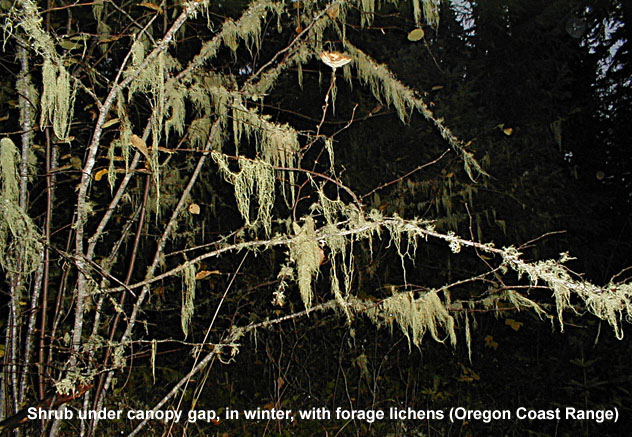
The most common tall shrub in the mountains of western Oregon and Washington is vine maple, Acer circinatum. Other tall shrubs include Arctostaphylos (manzanita), Ceanothus (buckbrush), Holodiscus (ocean spray), Prunus (cherries and plums), Rhamnus (cascara), Rhododendron, Sambucus (elderberry), Salix (willow), Symphoricarpos (snowberry), andViburnum.
In northern Idaho Rosso and Rosentreter (1999) hypothesized that shrubs can support many lichen species that are lost from a stand when it is commercially harvested. In this case, shrubs can be the "legacy" substrate allowing carryover of some epiphytic species from one generation of forest to the next.
All of the characteristics that favor old-growth associated epiphytes are readily recognizable by foresters, biologists, and other natural scientists, even without being able to recognize particular species of epiphytes. We offer a list below that could be used to score stands (management units) for their quality as habitat for epiphytes, particularly old-growth associated species. These habitat characteristics are broken down into two groups: stand structure and site characteristics. Stand structure can be manipulated with management activities, but site characteristics are normally fixed.
We are certain that these are valuable features for epiphytes. But they are not equally valuable, and we do not at present have a good basis for weighting them relative to each other. Research is needed to (a) develop the list into a formal scoring system by creating operational definitions for many of the words and proposing a quantitative index, (b) demonstrate the effectiveness of a scoring system based on these site and stand features, (c) refine the system on the basis of the successes and failures in "b".
Table: Checklist of habitat features promoting diversity and abundance of old-growth associated lichens:
|
|
|
| Located in the riparian zone of perennial stream, lake, or wetland | |
| Large rock outcrops or talus are present | |
| Located on a ridge top | |
| Contains infertile sites due to thin soils or extremely coarse textured soils | |
|
|
|
| Remnant old-growth trees in young stands (one or more remnants in sight from most places in the stand) | |
| Oregon ash (Fraxinus latifolia) present | |
| Old-growth forest | |
| Both conifers and hardwood trees present (more than 5% of mature stems in each category) | |
| Presence of wolf trees (conifers with large, living lower limbs) | |
| Significant presence of mature to old tall shrubs (averaging more than 10 per acre or 25 per hectare) | |