Chemistry 122 Spring 2004
Practice Final Exam Drapela
DO NOT OPEN
THIS EXAM UNTIL INSTRUCTED.
Instructions:
1. On the scantron form, fill in
your last name, first name, and middle initial, and the corresponding bubbles.
2. Fill in your student ID number, and the corresponding
bubbles.
3. CLASS SECTION NUMBER:
Leave blank.
4. TEST FORM NUMBER:
Leave blank.
5. Wait until instructed to begin test.
This exam consists of 50 multiple-choice questions worth 3
points each. Select the best answer by
filling in the corresponding circle on the rear page of the answer sheet.
If you have any questions during the exam, please raise your
hand to attract the attention of a proctor. The proctor will come to you. You may keep the exam when you are finished,
so please mark the answers you selected on it.
Good luck!
vapor pressure(solution) = [mole fraction(solvent)] x [vapor pressure(pure solvent)]
DT = Kf·m DT = Kb·m
Xn = moln/total mol
Methane
Ethane
Propane
Butane
Pentane
Hexane
Heptane
Octane
Nonane
Decane
- Is
oxygen paramagnetic?
- yes
- no
- Which
atom is the largest atom below?
- potassium
- bromine
- cesium
- astatine
- How
many dots are in the Lewis symbol for germanium?
- 2
- 4
- 6
- 8
- 10
- Which
element has the highest electronegativity of the
elements below?
- potassium
- bromine
- cesium
- astatine
- Which bond
is the longest?
- single
- double
- triple
- When
resonance structures are drawn, the true structure of the molecule represented
is:
- not
known
- an
average of all the structures
- any
single one of the structures
- polar
- non-existent
- What
is the bond order of the C-O bonds below?

- 0.5
- 1.0
- 1.5
- 2.0
- 2.5
- Which
bond below is non-polar?
- C-C
- C-N
- C-O
- C-F
- Br-Cl
- Which atom(s) in the ion below has a non-zero formal charge?

- nitrogen
- carbon
- sulfur
- nitrogen
and sulfur
- carbon
and sulfur
- Which
of the following species is isoelectric with Xe?
- I
- I−
- Ce
- Kr
- Br−
- How
many valence electrons does boron have?
- 1
- 2
- 3
- 5
- 10
- In the
correct Lewis structure for CCl2O,
the bond between C and O is a:
- single bond.
- double bond.
- triple bond.
- non-polar bond.
- hydrogen bond.
- What
is the molecular shape of the sulfate ion (SO42-)?
- linear
- t-shaped
- square
planar
- tetrahedral
- pyramidal
- Which
molecule below is non-polar?
- NH3
- HBr
- H2S
- PCl3
- CF4
- A p-bond is defined as a bond whose orbitals:
- do
not overlap
- overlap
end-to-end
- overlap
side-to-side
- are
the same size
- are
hybridized
- Which
of the following is a saturated hydrocarbon?





- The proper name for the compound below is:

- ethylcyclohexane
- 4-ethylhexane
- trihexane
- trioctane
- 3-ethylhexane
- Which of the following is an isomer of the compound in #17 above?





- The strongest force below is:
a.
b. ion-dipole forces
c. hydrogen
bonding
d. ion-ion forces
e. dipole-dipole forces
- Consider the phase diagram below.
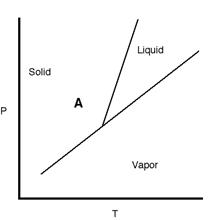
If
a substance begins at point “A” on the diagram and the pressure is steadily decreased, what
will happen to the substance?
- It will melt.
- It will freeze.
- It will boil.
- It will condense.
- It will sublime.
- If vanillin has a lower vapor pressure than benzophenone, this tells us that vanillin:
- has weaker intermolecular forces than benzophenone.
- has stronger intermolecular forces than benzophenone.
- can not hydrogen bond as well as benzophenone.
- has a lower boiling point than benzophenone.
- has a lower molecular mass than benzophenone.
- Which of the following factors works against solution formation?
- Lattice energy of the solute
- Solvation energy
- Entropy
- Ion-solute attractions
- All of the above
- The maximum solubility of oxygen in 100 g of water at 25 °C and 1.0 atm is 0.0040 g. What is the solubility of oxygen at the same temperature if the pressure is increased to 4.0 atm?
- 0.0010 g oxygen
- 0.0040 g oxygen
- 0.0080 g oxygen
- 0.0120 g oxygen
- 0.0160 g oxygen
- The vapor pressure of pure acetic acid at 90 °C is 332 Torr. What is the vapor pressure of a mixture of 2.0 mol acetic acid and 0.50 mol of aspirin (a non-volatile, non-dissociating solute)?
- 83.0 Torr
- 166 Torr
- 266 Torr
- 498 Torr
- 760 Torr
- Pure acetic acid boils at 118.3 °C. What is the boiling point of the solution in #24 above? (Acetic acid is C2H4O2. It has a Kb of 3.07 °C m-1, a Kf of 3.57°C m-1, and density of 1.0 g/ml)
- 112.7 °C
- 115.1 °C
- 118.3 °C
- 124.9 °C
- 131.1 °C
- Which of the following affects the rates of chemical reactions?
- catalysts
- concentration of reactants
- temperature
- chemical properties of reactants
- all of the above affect chemical
reaction rates
- The concentration of reactant A at the beginning of a reaction is 0.32 M. After 30 seconds, the concentration of A has dropped to 0.26 M. What is the average rate of reaction during this period?
- 0.020 M/s
- 0.50
M/s
- 1.3
M/s
- 2.6
M/s
- 3.2
M/s
- In the reaction below, the rate of disappearance of Na is 0.0083 M/s. At what rate is NaOH produced?
Na + 2 H2O à 2 NaOH + H2
- 0.0042 M/s
- 0.0083
M/s
- 0.017
M/s
- 0.64
M/s
- 0.83
M/s
- The rate law for the reaction above is shown below. If k = exactly 1,000 L2mol-2, what is the rate of this reaction when the concentration of water is 55.6 M and that of sodium is 0.0034 M?
Rate = k[Na]2[H2O]
- 0.0042 M/s
- 0.0083
M/s
- 0.017
M/s
- 0.64
M/s
- 0.83
M/s
For questions 30-33,
consider the following reaction:
2 NO + Cl2 à 2 NOCl
This reaction was
carried out three times at various concentrations. The results are shown in the table below:
|
[NO] |
[Cl2] |
Initial Rate (M/s) |
|
0.10 |
0.10 |
0.18 |
|
0.10 |
0.20 |
0.36 |
|
0.20 |
0.20 |
1.44 |
- What is the overall order of this reaction?
- 0
- 1
- 2
- 3
- 4
- Write the rate law for this reaction, then answer the following: What is the value of k?
- 36 180 L2mol-2
- 180
L2mol-2
- 1200
L2mol-2
- 8,400
L2mol-2
- 13,000
L2mol-2
- What would be the initial rate of reaction if the concentrations of both reactants were 1.0 M?
- 9.9 M/s
- 18
M/s
- 33
M/s
- 95
M/s
- 180
M/s
- Which molecule is involved in the rate-limiting step of the reaction?
- NO
- Cl2
- neither
one is involved
- both
are involved
~ ~ ~ ~ ~ ~ ~ ~ ~ ~ ~ ~ ~ ~
- Catalysts speed up reactions by:
- making molecules move faster
- increasing
the temperature of the reaction
- lowering
the activation energy
- increasing
the number of intermediates
- making
solutions more concentrated
For questions 35-38,
consider the reaction coordinate diagram below.
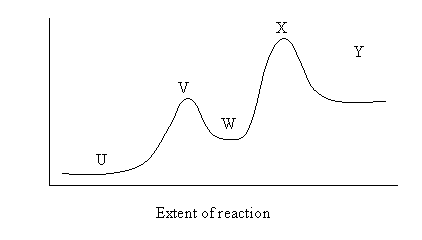
- The activation energy for the first step of this reaction is measured between…
- U and V
- U
and W
- U
and X
- U
and Y
- V
and X
- Which letter represents a transition state?
- U
- V
- W
- Y
- Both
U and Y
- Which letter represents an intermediate?
- U
- V
- W
- Y
- Both
V and X
- The rate-limiting step in the reaction above is:
- the first step
- the
second step
- the third step
- the fourth step
- all
steps are rate-limiting
- How do catalysts affect equilibrium constants such as Kc?
- They increase it.
- They
decrease it.
- Depends
on the temperature.
- Depends
on whether the reaction is endothermic or exothermic.
- They
have no effect.
For questions 40-44,
consider the following reaction:

At 1100 °C, Kc = 0.011 for this reaction.
The reaction is exothermic.
- At 1100 °C, which are favored at equilibrium?
- reactants
- products
- neither,
equilibrium lies near the middle
- 1.0 mol of SO2, 1.0 mol of O2, and 1.0 mol of SO3 are sealed in a container at 1100 °C. What is the value of Q at this point in time?
- 0.011
- 1.0
- 2.0
- 3.0
- zero
- With the initial conditions in #41 above, which way will the reaction proceed?
- to the left
- to the right
- neither
- If the system at equilibrium is cooled, what will happen?
- More O2 will be produced.
- More SO3 will be produced.
- Nothing.
- What is the value of Kc at 1100 °C for the reverse reaction?
- 0.011
- 0.11
- 1.0
- 91
- 3,300
For questions 45-47,
consider the following reaction:

- 12.0 mol SO2 and 4.0 mol NO2 are placed in a rigid, 2.0-L container. At equilibrium, only 10.0 mol SO2 are left. What is Kc for the reaction at this temperature?
- 0.20
- 0.59
- 3.7
- 11
- 87
- If 1.0 mol of all four substances are placed in a rigid, 1.0-L container at this same temperature, which way will the reaction proceed?
- to the left
- to
the right
- neither
- What would be the final concentration of NO at equilibrium, given the initial conditions in question #46?
- 0.0073 M
- 0.38
M
- 0.66
M
- 0.82
M
- 1.2
M
- Kc for a certain reaction is 94.2. When the system reaches equilibrium, which is true?
- There are more products than reactants.
- There
are more reactants than products.
- There
are equal amounts of products and reactants.
- Kc for another reaction is 0.00045. When the system reaches equilibrium, which is true?
- Products are forming more quickly than
reactants.
- Reactants
are forming more quickly than products.
- Products
and reactants are forming at the same rate.
- Consider
the following reaction:

What is the value of the equilibrium constant for this reaction if at equilibrium there are 2.0 mol of each of the three substances present?
- zero
- 0.20
- 0.50
- 1.0
- 2.0