
Old-growth forests favor certain lichen species that are much less frequent or absent in young forests. This conclusion has been reached everywhere in the world that this problem has been studied (examples in Table 1). In Europe, however, the problem is often conceived somewhat differently as "forest continuity" meaning temporal continuity of a forested state. Of course our old-growth forests have had long continuity as forests, but forests with long continuity may lack very old trees, particularly when the dominant species are shorter lived than in our forests. Whatever we call it, destruction of old forests is a worldwide threat to biodiversity of lichens (Wolseley 1995).
Table 1. Example studies contrasting lichen epiphytes in old forests with those in younger forests.
|
|
|
| British Columbia | Goward 1994, Goward & Arsenault 1997, Price & Hochachka 2001, Ryan et al. 1998 |
| Finland | Kuusinen 1994b, 1996; Kuusinen & Sitonen 1998 |
| Great Britain | Rose 1976, 1992 |
| Idaho (northern) | Rosso & Rosentreter 1999 |
| Montana (western) | Lesica et al. 1991, McCune & Antos 1982 |
| New England, USA | Selva 1994 |
| Norway | Holien 1998, Rolstad et al. 2001 |
| Oregon & Washington (western) | McCune 1993; Neitlich 1993; Neitlich & McCune 1997; Peterson & McCune 2001; Pipp et al. 2001; Rosso et al. 2000a |
| Oregon & Washington (eastern) | Lehmkuhl 2004 |
| Sweden | Esseen et al. 1996; Fritz & Larsson 1997; Tibell 1992; Dettki & Esseen 1998 |
| Tasmania | Brown et al. 1994 |
Differences in biomass and species composition tend to be stronger than differences in total epiphyte diversity. While in some cases the total diversity may not differ much from mature stands, old forests differ in species composition from younger forests (Lesica et al. 1991, Peterson & McCune 2001). In other words, some species are more abundant in old forests than in young forests.
The association of many lichens with old-growth forests is the reason that lichens were considered in the Northwest Forest Plan. While some of these species are truly rare, many are not. Nevertheless, because of their association with old-growth forests, forest management practices threatened these species. This threat may be compounded by susceptibility to air pollution.
Because epiphytic lichens have roles in the ecosystem, we need to do more than just ensure the survival of these species. Normal functioning of the system requires maintaining normal levels of biomass of epiphytic lichens. For example, while it is fairly easy to find small amounts of the nitrogen-fixer Lobaria oregana in young forests, the biomass of L. oregana is always minuscule compared to the ton/hectare expected in old forests between about 400 and 1000 m (1300-3200 feet) in elevation. Conversion of old forests to young forests may not completely eliminate Lobaria oregana, but it may virtually eliminate its roles in the ecosystem.
Lobaria oregana and probably many other lichens are associated with old-growth forests not because they cannot thrive in younger forests, but rather because they are dispersal-limited. This has been demonstrated for Lobaria oregana (Sillett et al. 2000, 2000b) in Oregon, Platismatia norvegica and Lobaria scrobiculata in Norway (Hilmo & Sastad 2001), and inferred for other species and in other parts of the world (Dettki et al. 2000; Esseen et al. 1996; Gu et al. 2001; Keon 2001; Peck & McCune 1997a; Sillett & Goslin 1999; Sillett & McCune 1998). DNA-based methods for detecting lichen propagules (Walser et al. 2001) have the potential to rapidly expand our understanding of the dispersal ecology of lichens.
One of the most surprising and telling
results in the course of our research was that old-growth associated
lichens transplanted to younger forests often grow as well or
better than in old forests. This was found for Lobaria oregana
(Sillett & McCune 1998,
Sillett et al. 2000), Lobaria
pulmonaria (Sillett et
al. 2000), Pseudocyphellaria rainierensis (Sillett & McCune 1998),
and Usnea longissima (Keon
2001). In most of these cases growth rates were also high
when transplants were hung on racks in clearcuts (excluding Pseudocyphellaria
rainierensis).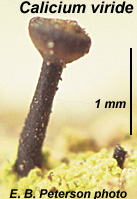
Other species are probably old-growth associated because they are substrate limited rather than dispersal limited. For example, some calicioid species (pin lichens) appear to require old bare wood on snags or old bark in humid habits (Peterson & McCune 2001b, Selva 1994, Tibell 1992).
Table 2. Epiphytic lichens with the strongest demonstrated old-growth association in the Pacific Northwest. Limitations in most cases are inferred from distribution patterns and modes of reproduction. References demonstrate the old-growth association (Lesica et al. 1991) or association with old remnants (e.g. Neitlich & McCune 1997) but do not necessarily demonstrate the limitations. These are not the only old-growth associates, only some of the better known examples.
| Species | Species group |
|
|
| Alectoria sarmentosa | forage lichen | dispersal | Dettki & Esseen 1998, Holien 1998, Lesica et al. 1991, Neitlich & McCune 1997 |
| Alectoria vancouverensis | forage lichen | dispersal | Neitlich & McCune 1997 |
| Bryoria pseudofuscescens | forage lichen | dispersal | Neitlich & McCune 1997 |
| Calicium glaucellum | pin lichen | substrate availability | Holien 1998; Peterson & McCune 2001b |
| Calicium lenticulare | pin lichen | substrate availability | Peterson & McCune 2001b) |
| Calicium viride | pin lichen | substrate availability; fails in excess shade and moisture | Holien 1998; Peterson & McCune 2001b |
| Chaenotheca trichialis | pin lichen | substrate availability; fails in excess shade and moisture | Holien 1998; Peterson & McCune 2001b |
| Chaenothecopsis nana | pin lichen | substrate -- requires old Pseudotsuga bark | Peterson & McCune 2001b |
| Letharia vulpina | matrix lichen (green-algal fruticose) | old, dry substrates | Neitlich & McCune 1997, Tonsberg et al. 1996 |
| Lobaria oregana | cyanolichen | dispersal, air quality | Goward 1994, McCune 1993, Neitlich & McCune 1997, Sillett & McCune 1998, Rhoades 1983, Sillett & Goslin 1999, Sillett et al. 2000 |
| Nephroma occultum | cyanolichen | disperal, air quality | Goward 1994, Rosso et al. 2000 |
| Parmelia pseudosulcata | matrix lichen (green-algal foliose) | dispersal | Goward 1994, Neitlich & McCune 1997 |
| Platismatia norvegica | green-algal foliose | dispersal | Goward 1994, Hilmo & Sastad 2001, Holien 1998, Rolstad et al 2001 |
| Pseudocyphellaria rainierensis | cyanolichen | dispersal, air quality, exposure | Sillett & Goward 1998, Sillett & McCune 1998 |
| Ramalina thrausta | forage lichen | dispersal, air quality, exposure; low elevations only | Holien 1998, Kuusinen et al. 1995, Neitlich & McCune 1997, Rolstad et al 2001, Tonsberg et al. 1996, Wedin 1989 |
| Sphaerophorus globosus | matrix lichen (green-algal fruticose) | ? | Goward 1994, Neitlich & McCune 1997, Rolstad et al 2001 |
| Sticta weigelii | cyanolichen | dispersal, air quality | personal observation |
| Usnea cavernosa | forage lichen | dispersal, air quality; in the PNW too sparse to be well represented in ecological sampling | personal observation |
| Usnea longissima | forage lichen | dispersal, air quality | Doell 1997, Esseen et al. 1981, Gauslaa 1997, Gauslaa et al. 1992, 1998, Keon 2001 |
| Usnea scabrata | forage lichen | dispersal | Neitlich & McCune 1997 |