
Although we have a clear demonstration of the benefit of green-tree retention, the problem of whether the trees should be left aggregated, dispersed, or a mixture of both is more difficult. Only one study has attempted to address this question directly (Sillet & Goslin 1999, see below). The long-term experiments needed to answer it definitively would not yield a conclusive answer for many decades (for example, see the "demo study", Pipp et al. 2001). It is easy to speculate, but for empirical evidence we are forced to turn to inference from retrospective studies.
Sillett & Goslin (1999) examined the spatial pattern of litterfall of Lobaria oregana in a 2 hectare stand with a variable density of remnant trees from previous generations. The stand was located in the central Oregon Cascades. The most recent major disturbance was ca. 100 years before sampling. Statistical analysis of the relationship between the pattern of Lobaria litterfall and the remnant trees demonstrated (a) the importance of the remnant trees as source areas for Lobaria spreading into the younger cohort, and (b) slightly enhanced Lobaria populations in areas of aggregated remnant trees. Thus, the positive effect of aggregated remnant trees was somewhat greater than the sum of that number of dispersed remnant trees.
If old-growth associated lichens are dispersal limited, and if they can survive the opening of the canopy, then maximizing the number of dispersion of remnant trees should maximize lichen biomass in the future stand. Sillett et al. (2000) used a decision matrix to represent this problem:
Table 1. Decision matrix for maintenance of old-growth-associated epiphytes in managed forests, depending on the factors limiting rates of population development. The conclusion for Lobaria oregana is indicated in boldface type (from Sillett et al. 2000).
| Microenvironments strongly limiting? | ||
| Dispersal strongly limiting? | Yes | No |
| Yes | Maximize number of retained trees using closely-spaced clumps of retention. | Maximize number of retained trees using dispersed patterns. |
| No | Retain trees as aggregates to conserve as much of the intact habitat as possible. | Green tree retention would not affect epiphyte recovery. |
The primary theoretical objection to the likely effectiveness of dispersed remnant trees as propagule sources is a concern that drastic opening of the canopy will kill the old-growth associated lichens in the remnant trees. Opening the canopy of a forest by removing most of the trees is likely to stress the epiphytes in the remaining trees (Gauslaa & Solhaug 1996, 1999, 2000, Gauslaa et al. 2001). Lichens acclimate to exposed conditions by melanization (Gauslaa & Solhaug 2001) and accumulation of other pigments and UV absorbing compounds (Rikkinen 1995). Existing evidence on lichen response to edges are ambivalent: subtle negative and positive effects have been seen for various species (Esseen & Renhorn 1998b, Hilmo 2002, Kivisto & Kuusinen 2000, Renhorn et al. 1997, Sillett 1994, 1995).
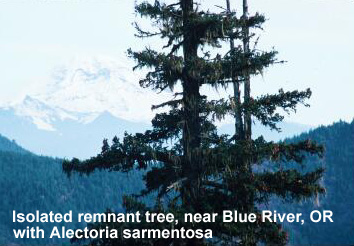 Do
old-growth associated lichens survive drastic opening of the canopy?
That will depend on the specific microsite of an individual. It
must survive the initial shock, then acclimate to the new environment.
Tree crowns are so structurally complex that some individuals
will probably survive in relatively sheltered microsites. Individuals
already growing in relatively exposed microsites may be pre-conditioned
to the new environment.
Do
old-growth associated lichens survive drastic opening of the canopy?
That will depend on the specific microsite of an individual. It
must survive the initial shock, then acclimate to the new environment.
Tree crowns are so structurally complex that some individuals
will probably survive in relatively sheltered microsites. Individuals
already growing in relatively exposed microsites may be pre-conditioned
to the new environment.
We need studies that follow the most environmentally sensitive old-growth-associated species, such Pseudocyphellaria rainierensis and Nephroma occultum, on remnant trees before and after logging. For other more common species, such as Lobaria oregana, the higher biomass that develops in areas with remnant trees from historical disturbances (Sillett & Goslin 1999; Peck & McCune 1997a) attests to the survival of populations in remnant trees.
The available evidence leads to the following recommendations: