CH 222 Syllabus
I. Meeting Information
|
Lectures: |
MWF |
8:00-8:50am |
125 LPSC (Reser Auditorium) |
Nafshun |
|
|
MWF |
11:00-11:50am |
125 LPSC (Reser Auditorium) |
Watson |
|
|
MWF |
1:00-1:50pm |
125 LPSC (Reser Auditorium) |
Ferguson |
|
|
MWF |
3:00-3:50pm |
125 LPSC (Reser Auditorium) |
Ferguson |
| TR |
8:00-9:20am |
125 LPSC (Reser Auditorium) | Nafshun |
|
Exams: |
Exam
1 |
Thursday, February 2, 2012 |
7:00-8:20pm |
|
|
Exam
2 |
Thursday, March 1, 2012 |
7:00-8:20pm |
|
|
Final Exam |
Monday, March 19, 2012 |
8:00-9:50pm (Good Evening!) |
II. Contact Information
Faculty
|
Dr.
Richard Nafshun |
Richard.Nafshun@oregonstate.edu |
|
|
Office Hours: T 9:30am, W 9am, R 10am in 239 LPSC |
||
|
|
Philip.Watson@oregonstate.edu |
|
|
Office Hours: M 3pm, W 3pm, F 3pm in 147 GILB |
||
|
Dr. Morgan Ferguson |
Morgan.Ferguson@oregonstate.edu |
|
|
Office Hours: M 2pm, W 2pm, W 4pm in 239 LPSC |
||
|
CH 222 offers the student many
opportunities to meet with Faculty and Staff. Feel free (and you are
encouraged) to visit your instructor during office hours with any
administrative or chemistry questions you may have. You may also visit with
the other course Faculty (if you are in Dr. Nafshun's class, you may attend
Dr. Watson's or Dr. Ferguson's office hours) for help with chemistry questions.
There are a total of nine unique office hours each week. Additionally, the
Mole-Hole (below) is open 50 hours each week. |
The Mole-Hole
The Mole-Hole is the general chemistry tutorial room--staffed by Teaching Assistants and Faculty . It is located in the Collaborative Learning Center (CLC) which is in the southeast corner of the main floor of the Valley Library. Students are encouraged to drop by for assistance; no appointment is necessary. The Mole-Hole is generally open during weeks 2-10 of the term:
Monday-Thursday:
11:00am-10:00pm
Friday: 11:00am-3:00pm
Saturday: Closed
Sunday: 3:00pm-10:00pm
And open for limited hours during Finals Week.
The link to the Mole-Hole, including the schedule is: http://www.chem.orst.edu/courses/molehole.html
III. Tentative Lecture Schedule
|
Week |
Meeting |
Day |
Topic |
Reading Assignment |
Lab |
Mastering |
|
|
0 |
0 |
|
Review Reading |
9.1-9.11 |
|
|
|
|
1 |
1 |
M |
Introduction to Chemistry 222 |
10.1-10.2 |
Lewis Structures and VSEPR Theory |
Introduction Chapter 10 |
Molecular Structures (NMR) |
|
2 |
W |
Bonding II |
10.3-10.4 |
||||
|
3 |
F |
Bonding II |
10.5-10.6 |
||||
|
|
|||||||
|
2 |
|
M |
No Class - MLK Jr. |
|
No
Week 2 Labs |
Chapter 10 |
|
|
4 |
W |
Bonding II |
10.7 |
||||
|
5 |
F |
Bonding II |
10.8 |
||||
|
|
|||||||
|
3 |
6 |
M |
Gases |
5.1-5.4 |
HyperChem |
Chapter 5 |
|
|
7 |
W |
Gases |
5.5-5.8 |
||||
|
8 |
F |
Gases |
5.9-5.11 |
||||
|
|
|||||||
|
4 |
9 |
M |
Liquids, Solids, and Intermolecular Forces |
11.1-11.4 |
Gases |
Mastering Chemistry Chapters 10 and 5 should be completed by this time |
|
|
10 |
W |
Review of topics |
|||||
|
|
R |
Exam
1--7:30-8:50 p.m. |
|||||
|
11 |
F |
Liquids, Solids, and Intermolecular Forces |
11.5-11.8 |
||||
|
|
|||||||
|
5 |
12 |
M |
Liquids, Solids, and Intermolecular Forces |
11.9-11.11 |
Metals+ HCl (OCL) |
Chapter 11 |
Metals + HCl |
|
13 |
W |
Liquids, Solids, and Intermolecular Forces |
11.12-11.13 |
||||
|
14 |
F |
Solutions |
4.4-4.7 |
||||
|
|
|||||||
|
6 |
15 |
M |
Solutions |
12.1-12.4 |
TLC |
Chapter 12 Chapter 13 |
Osmotic Pressure |
|
16 |
W |
Solutions |
12.5-12.8 |
||||
|
17 |
F |
Kinetics |
13.1-13.2 |
||||
|
|
|||||||
|
7 |
18 |
M |
Kinetics |
13.3-13.4 |
FPD |
Chapter 13 |
|
|
19 |
W |
Kinetics |
13.5-13.6 |
||||
|
20 |
F |
Kinetics |
13.7 |
||||
|
|
|||||||
|
8 |
21 |
M |
Radioactivity and Nuclear Chemistry |
19.1-19.3 |
Kinetics I |
Mastering Chemistry Chapters 11, 4, 12, and 13 should be completed by this time |
|
|
22 |
W |
Review of topics |
|||||
|
|
R |
Exam
2--7:30-8:50 p.m. |
|||||
|
23 |
F |
Radioactivity and Nuclear Chemistry |
19.4-19.5 |
||||
|
|
|||||||
|
9 |
24 |
M |
Radioactivity and Nuclear Chemistry |
19.6-19.8 |
Kinetics II |
Chapter 19 Chapter 14 |
Nuclear |
|
25 |
W |
Radioactivity and Nuclear Chemistry |
19.9-19.12 |
||||
|
26 |
F |
Equilibrium |
14.1-14.3 |
||||
|
|
|||||||
|
10 |
27 |
M |
Equilibrium |
14.4-14.5 |
Nuclear (OCL) |
Chapter 14
Mastering Chemistry Chapters 19 and 14 should be completed by this time |
|
|
28 |
W |
Equilibrium |
14.6-14.7 |
||||
|
29 |
F |
Equilibrium |
14.8-14.9 |
||||
|
|
|||||||
|
Finals |
|
|
Special
Note: Final Exam |
|
|
|
|
IV. Prerequisites
One year of high school chemistry and acceptable aptitude
test scores or CH 121. CH 221, CH 222, CH 223 must be taken in order.
V. Course Description
CH 222. GENERAL CHEMISTRY (5). A general chemistry sequence for students majoring in most sciences, pharmacy, and chemical engineering. CH 121 is accepted in lieu of high school chemistry as a prerequisite for this sequence. Lec/lab/rec. (Bacc Core Course)
The textbook ($) (required) is Chemistry,
A Molecular Approach, by Tro, 2/ed, Prentice Hall.
The solutions manual for the textbook ($) (optional) is available for "solutions manual type students."
The online homework ($) (required) is Mastering Chemistry, Prentice Hall.
The online chemistry laboratory package ($) (required) www.onlinechemlabs.com .
The on-campus laboratory manual ($) will be issued during your first visit to the general chemistry laboratory (week 2 of the term).
Laboratory goggles, a lab towel, and a lab coat ($) will be issued during your first visit to the general chemistry laboratory (week 2 of the term).
A laboratory notebook is not used in CH 222.
Any scientific calculator ($) (required) will be used broadly in CH 222.
Various packages consisting of the
textbook, solutions manual, and Mastering Chemistry are available at the OSU
Bookstore.
The text link at the OSU Bookstore
can be accessed through:
VIII. Baccalaureate Core
Successful completion of CH 222 partially fulfills OSU's Baccalaureate Core course requirements in the Perspectives category under Physical Science (Lab). Physical Science Baccalaureate Core Rational: Science seeks to develop a fundamental description and understanding of the natural world, from elementary particles to the cosmos, including the realm of living systems. Students should have the opportunity to explore the insights of science, to view science as a human achievement, and to participate in scientific inquiry. This experience includes the challenge of drawing conclusions based on observation, analysis, and synthesis. CH 221, 222, 223 has adopted the "atoms first" approach to teaching general chemistry. This means that early on we will discuss quantum mechanics and the seminal experiments that have lead to our current conception of atomic structure and function. One advantage to this approach is that it emphasizes the tentative nature of science. Science, and by extension chemistry, will be viewed as a process rather than a static set of facts. The process of 'doing science' will be further explored in the laboratory component of these courses. Students will perform experiments, collect, analyze, and draw conclusions from the data, and write formal laboratory reports to communicate the results of the experiments.
IX. Grading
| CH 222 Grade Sheet | |||
| Exam/Quiz/Assignment | Date | Points | Your Score |
| Exam 1 (Please do not miss) | 7:00pm 2-Feb | 112 | |
| Exam 2 (Please do not miss) | 7:00pm 1-Mar | 112 | |
| Final Exam (You cannot miss!) | 8:00pm 19-March | 168 | |
| Mastering Chemistry (MC) Homework | Posted within MC* | 82 | |
| Recitation Quiz 1 | Week 3 | 4 | |
| Recitation Quiz 2 | Week 4 | 4 | |
| Recitation Quiz 3 | Week 5 | 4 | |
| Recitation Quiz 4 | Week 6 | 4 | |
| Recitation Quiz 5 | Week 7 | 4 | |
| Recitation Quiz 6 | Week 8 | 4 | |
| Recitation Quiz 7 | Week 9 | 4 | |
| Recitation Quiz 8 | Week 10 | 4 | |
| <Drop your lowest 4-point recitation quiz> | < > | ||
| Lab Quiz 1 (HyperChem) | Week 3 | 4 | |
| Lab Quiz 2 (Gases) | Week 4 | 4 | |
| Lab Quiz 3 (TLC) | Week 6 | 4 | |
| Lab Quiz 4 (FPD) | Week 7 | 4 | |
| Lab Quiz 5 (Kinetics I) | Week 8 | 4 | |
| Lab Quiz 6 (Kinetics II) | Week 9 | 4 | |
| <Drop your lowest 4-point lab quiz> | < > | ||
| Lab 0 (Safety) | Week 1 | 10 | |
| Lab 1 (Molecular Models) | Week 1 | 22 | |
| Lab 2 (HyperChem) | Week 3 | 22 | |
| Lab 3 (Gases) | Week 4 | 22 | |
| Lab 4 (TLC) | Week 6 | 22 | |
| Lab 5 (FPD) | Week 7 | 22 | |
| Lab 6 (Kinetics I) | Week 8 | 22 | |
| Lab 7 (Kinetics II) | Week 9 | 22 | |
| <Drop your lowest 22-point lab> | < > | ||
| There are a maximum of 162 laboratory and laboratory quiz points possible. A minimum score of 97 points (60%) is required for a D- or higher in CH 222. | |||
| www.onlinechemlabs.com Molecular Structures (NMR) | Due 27-Jan | 9 | |
| www.onlinechemlabs.com Metals + HCl | Due 17-Feb | 9 | |
| www.onlinechemlabs.com Osmotic Pressure | Due 24-Feb | 9 | |
| www.onlinechemlabs.com Nuclear | Due 16-Mar | 9 | |
| Final Score | 700 | ||
|
|
|||
|
|
|
|
|
|
CH 222 is a non-competitive
course: |
|
|
|
Course Coverage: Bonding II (Chapter 10), Gases (5), Liquids & Solids (11), Solutions (4), Solutions (12), Kinetics (13), Radioactivity and Nuclear Chemistry (19), Equilibrium (14)
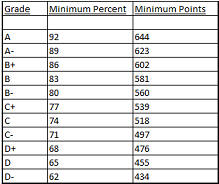
A grade in this class will be obtained through the point system outlined on the CH 222 Student Grade Sheet; 644 points for an A, 623 for an A-... If you write a higher percentage score on the final exam than on the midterm exams, the final exam percentage will be used as a score for all three term exams (see the CH 222 Student Grade Sheet). There is nothing to sign-up for. It is an automatic win-win situation. This is a mechanism which gives students who experienced educational difficulty during the term for any reason a chance to demonstrate that they have mastered the material and to profit from that mastery. There are no "make-up exams," "early exams," "alternate exams," "extra-credit assignments," or "deals." If you miss Exam 1 or Exam 2 due to a choice or unavoidable event, the above mechanism will be used. If you were sick during Exam 1 but took the exam, know that you can ace the Final Exam and still earn an "A" in CH 222. If you score 96% on Exam 1 and 100% on Exam 2, know that you need master a small amount of new material to perform excellently on the cumulative final exam to maintain your "A." You must take the CH 222 final exam. You cannot reschedule the final exam.
A minimum score of 60% of the laboratory points is required for a D- or higher in CH 222 (see the CH 222 Student Grade Sheet).
Exams 1 and 2
Two midterm exams (Exams 1 and 2) will be administered during the course. These exams will contain problems similar to those discussed in class. These exams are administered during the 80 minute evening exam periods. Because exams are promptly marked and returned to students, no make-up exams can be administered. A missed exam will receive a score of zero.
Exam Supplies: Bring THREE number two pencils, a calculator without a cover, a 3" x 5" notecard with handwritten notes on two sides, and a good eraser to each exam. YOU MUST BRING YOUR OSU CARD TO THE EXAM AND PRESENT IT TO THE PROCTOR UPON COMPLETION OF THE EXAM. DO NOT FORGET YOUR OSU CARD. THIS IS YOUR FORM OF I.D. AND THE PROCTOR MAY NOT ACCEPT YOUR EXAM WITHOUT THIS FORM OF I.D. If you bring notes, papers, or books to the exam, place them in a sealed pack and place the pack at the front of the classroom. You will be provided with a periodic table.
Final Exam
Please be on time. A late student may disturb the other students. The final exam is comprehensive and will be administered during the 110 minute period. The final exam cannot be rescheduled. A missed final exam will receive a score of zero.
Exam Supplies: Bring THREE number two pencils, a calculator, a 3" x 5" notecard with handwritten notes on two sides, and a good eraser to each exam. YOU MUST BRING YOUR OSU CARD TO THE EXAM AND PRESENT IT TO THE PROCTOR UPON COMPLETION OF THE EXAM. DO NOT FORGET YOUR OSU CARD. THIS IS YOUR FORM OF I.D. AND THE PROCTOR MAY NOT ACCEPT YOUR EXAM WITHOUT THIS FORM OF I.D. If you bring notes, papers, or books to the exam, place them in a sealed pack and place the pack at the front of the classroom. You will be provided with a periodic table.
Mastering Chemistry
Problems from Mastering Chemistry are assigned. Scores are assigned based on the number of assignments mastered.
Recitation Quizzes
Recitation quizzes will be administered during recitation. A missed quiz will receive a score of zero. There are no make-up quizzes. Your lowest quiz score will be dropped. Recitation quizzes contain questions covering lecture material.
Lab Quizzes
Lab quizzes will be administered during recitation. A missed quiz will receive a score of zero. There are no make-up quizzes. Your lowest quiz score will be dropped. Lab quizzes contain questions covering lab material. The quiz covers the laboratory to be investigated in the following laboratory. For example, the Density Lab will be investigated in Week 3. The student should read the Density Lab before Week 3 and utilize the Mole-Hole and Office Hours for any clarification. The Week 3 Lab Quiz will cover Density Lab concepts.
Laboratories
Students will submit the laboratory packet in recitation one week after the laboratory is completed. For example, during Week 3 the students will investigate the Density Lab. The Density Lab packet will be turned in during recitation during Week 4. The Aspirin packet and lab report will be submitted during Week 7. The Sunscreen packet will be submitted during recitation during Week 10 due to the Thanksgiving Holiday. There are no make-up labs. A missed lab will receive a score of zero. The lowest lab score will be dropped. If you miss one of the Aspirin labs you may earn half credit (because this is a double lab).
www.onlinechemlabs.com
Five online chemistry laboratories are assigned. Scores are based on completion and the quality of responses.
X. Services for Students with Disabilities
Accommodations are a collaborative effort between students, faculty, and the Disability Access Services (DAS) office. Students with accommodations approved through DAS are responsible for contacting the faculty member in charge of the course prior to, or during, the first week of the term to discuss accommodations. Students who believe they are eligible for accommodations, but who have not yet obtained approval through DAS, should contact DAS immediately at 541-737-4098.
XI. Expectations for Student Conduct
Student conduct is governed by the universities policies,
as explained in the Office of Student Conduct: Information and
Regulations. In an academic community, students and faculty, and staff
each have responsibility for maintaining an appropriate learning environment,
whether online or in the classroom. Students, faculty, and staff have the
responsibility to treat each other with understanding, dignity, and respect.
Further information may be found at: http://oregonstate.edu/studentconduct/home/index.php
XII. Academic Integrity
Students are expected to comply with all regulations pertaining to academic dishonesty, defined as: An intentional act of deception in which the student seeks to claim credit for the work or effort of another person or uses unauthorized materials or fabricated information in any academic work. For further information, visit Avoiding Academic Dishonesty, or contact the office of Student Conduct and Mediation at 541-737-3656 or http://oregonstate.edu/studentconduct/home/index.php
XIII. Student Resources
Your success in Chemistry 222 is very important to me! You have the following resources to help you with your study:
Lecture
Meetings (schedule at the top of this page)
Textbook Reading (reading assignments are listed at the top of this page)
Recitation Sessions
Worksheets (link available on the CH 222 homepage)
Mole Hole Tutors ( http://www.chem.orst.edu/courses/molehole.html
)
Mastering Chemistry ( www.masteringchemistry.com
)
OnlineChemLabs ( www.onlinechemlabs.com
)
Instructor Office Hours (schedule at the top of this page)
XIV. Time for Chemistry 222
Your success in Chemistry may be dependent on the amount of time you devote to the mastery of the material we discuss during the term. Chemistry 222 is a five credit course. Generally, one credit is given for three hours per week--in and out of class--of work. We meet for lecture three hours per week, and we meet for recitation/lab four hours per week. We recommend you work on Chemistry 222 outside of class ten to fifteen hours per week.